 US Dollars
 AUD
AUD
 CAD
CAD
 POUNDS STERLING

Shop by Category
Shop by Brand
Shop by Brand
BYZANTINE COIN JEWELRY
 Perhaps no other epoch in history is so unique, extensive and yet, as much forgotten as that of the Byzantine Roman Empire. From the founding of its new capitol in Constantinople, 330 AD to its final fall to the Turk invaders in 1453, over eleven hundred years of history has virtually been lost in most minds of the Western world. Ironically, it is this exact history that has extensively shaped the Western cultures today, especially those of the Christian faith.
No event in Western history was probably more pivotal than that of the Christian conversion of the Roman emperor Constantine I. Up to that time, Christians were heavily persecuted by many of the previous emperors and the religion was outlawed. That would all change in 324 AD with a miraculous military victory and subsequent conversion to Christianity by Constantine I at the Milvian Bridge. From this point on, Christianity became the official religion of the Empire. A new capitol was established in Constantinople (present day Istanbul, Turkey) and power was fully transferred from Rome to Constantinople in 476 AD. It was not the end of the Roman Empire but a continuation and fascinating transformation of Roman rule that would last for another one thousand years!
 In the Byzantine Period, the Roman Empire and Christianity were completely interwoven. It was the quintessential example of the UNION of church and state. What was once the ancient world's greatest enemy of the faith, overnight became its most devoted advocate. The classic architecture, style of dress, and overall appearance of all that was "Old Rome" took on a new and intricate style that the world has never seen before or since. This was not only attributed to the influence of the capitol's new geographic location, but also to the foremost prominence of Christianity in the Roman world. The evolution of Roman coinage in the Byzantine Period best exhibits the evolution of the Empire itself.
In the early years of the 6th and 7th centuries AD, the coins continue in the tradition of Rome with stylistic similarities in Imperial portraiture and personifications. Over time, the imagery became increasingly religious. Previous Roman personifications took on new Christian symbolism. Nike, the flying god of victory, now was an angel. The globe, which was previous depicted in the emperor's hand symbolized the ruler's dominion over the world. The new addition of a cross on top of the globe now represented the emperor's position as leader of both, church and state.
 The halo (nimbus) was used by emperors in Roman imagery even before the Empire's conversion to Christianity. Now it takes on a new and deeper meaning of religious enlightenment. The emperor Justinian II (685 - 695 AD) first issued coins that feature a portrait of Christ. After the period of Iconoclasm, nearly all coins minted were exclusively religious. This concept of minimal to no promotion of the ruling emperor on his coins was completely contrary to what coinage meant for the Roman Empire before Constantine's conversion. After all, Rome's initial and ONLY message on its coins for the entire duration leading up to this conversion was specifically to promote the emperor and state.
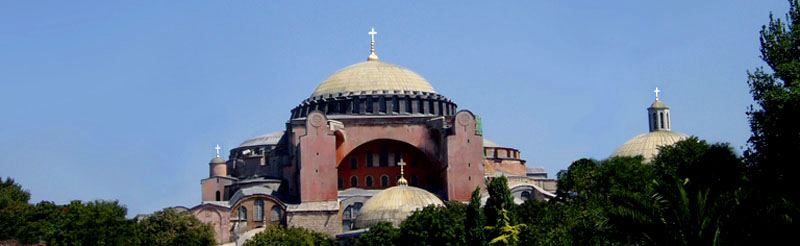
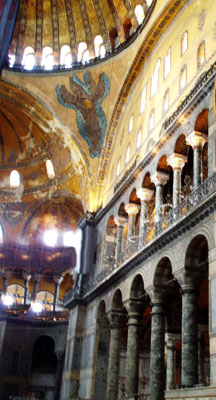 One of the most impressive treasures of Byzantium is the main Christian church that was built there in the sixth century by Emperor Justinian. After previous calamities with earlier structures, Justinian ordered the construction of a new church which was to surpass in magnificence all earlier churches and be unlike anything the world had ever seen. Historians write that he personally supervised the construction and made full use of all his empire could offer. The two most famous architects of the time were entrusted with the construction of the building which involved one hundred master builders and ten thousand laborers.
Only the finest and most exotic materials from all over the world would suffice for the construction of Constantinople's new magnificent church called Hagia Sophia, meaning 'Holy Wisdom". This included columns previously taken to Rome from an Egyptian temple in Heliopolis, a door from an ancient Babylonian temple and ivory and gold ornaments from ancient temples in Ephesus, Kizikos and Baalbek. The amazingly short duration of construction (less than 6 years!) and the revolutionary physics of its architecture still confound modern analysis. This wondrous monument was completed on December 27, 537 AD. During the dedication ceremony, Emperor Justinian put aside formalities of state and entered the church excitedly, to say a prayer of thanks to God for allowing him to fulfill his greatest dream. As he stared up at the massive dome and cavernous ceilings, he reflected upon the historical splendor of the temple in Jerusalem and shouted with joy, "Oh, Solomon, I have surpassed thee!". Sadly, Hagia Sophia was converted to a mosque when the Turks overran and defeated Constantinople and the Empire in 1453 AD. Incredibly detailed mosaics were hastily covered with plaster and all Christian symbols were removed, defaced or permanently covered. Today, the structure is a museum and has been partially restored to its Christian-era splendor.
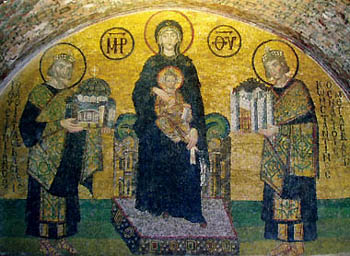 Another well-known remnant of the Byzantine Period is the stunning and unique art of the religious Icons. This abstract spiritual style can be immediately recognized and is evident in not only paintings and mosaics but also the era's architecture and coins. What was once thought of as crude numismatic issues are now appreciated as highly stylized symbols of the Romans' devout faith.
After the establishment of Constantinople as the new capitol and navel of the Roman world, the Empire continued for almost a millennium eventually bridging ancient and medieval history but not without its share of enemies. Numerous challenges of foreign armies took its toll on defenses and finally, on May 29, 1453 AD, the Muslim Ottomans overran the crumbling city walls and the sun set forever on the greatest empire that the ancient world had ever known.
SPECIAL NOTE: Some confuse the Byzantine Romans with followers of the Roman Catholic church. This is NOT the case. At the time of the Byzantine Roman period where the center of the Roman Empire was based in the East, the Vatican emerged in the West and tried to influence Roman rule but was never successful. Byzantine Romans were CHRISTIAN ORTHODOX, NOT Roman Catholic. During the Byzantine Period, eastern Romans possessed disdain for the Catholic church's desire for their subordination. With the exception of a few later period emperors that were hoping for financial support of the Vatican as the Empire crumbled in its final days, the majority of Eastern Byzantine Roman emperors themselves, were not Catholic, nor would ever convert.
- TEXT AND IMAGES COPYRIGHT JOHNBMCNAMARA.COM